Motor KV and RPM calculator
Motor KV is RPM per volt with no load, so RPM = KV x volts. A 3500KV motor on 3S (11.1 V) spins about 38,850 RPM, and 44,100 RPM on a fresh 12.6 V pack.
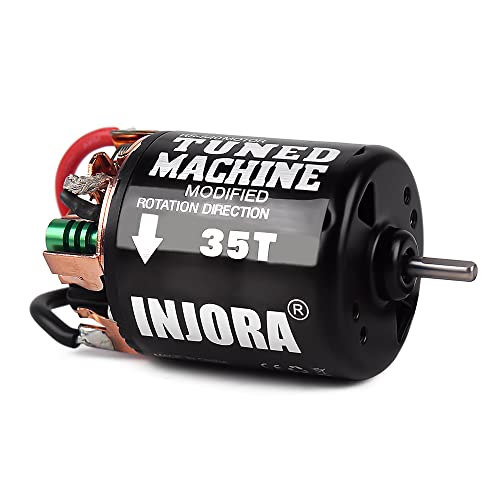
INJORA 540 Brushed Motor 35T Waterproof Motor for 1/10 RC
- 1/10
- Brushed
Motors and packs for this setup. Picked from current listings.
$13.98 listed price, changes often
Check price on Amazon- RPM on a full charge
- 44,100
- Pack voltage
- 11.1 V nominal, 12.6 V full
- Speed ceiling
- 49.7 mph
- Realistic
- 42.2 mph
- Wheel RPM
- 3,885
The formula
RPM (nominal) = KV x cells x 3.7 V
RPM (full charge) = KV x cells x 4.2 V
speed ceiling mph = RPM / FDR x tire diameter x pi x 60 / 63,360
KV describes unloaded speed only. It says nothing about power or torque on its own: a low KV motor on more cells can make far more power than a high KV motor on fewer.
Motors and packs for this setup
Picked from current listings across the price range, so there is a budget, a middle and a premium option in each category.


What does KV mean on an RC motor?
KV is the RPM a brushless motor turns per volt with no load. A 3500KV motor fed 7.4 V turns about 25,900 RPM; fed 11.1 V it turns about 38,850 RPM. The K comes from the motor velocity constant, not from kilovolts.
Because RPM depends on voltage, KV only means something paired with a cell count. That is why the same car can be "35 mph on 2S" and "50 mph on 3S" with nothing changed but the battery. The KV explained guide covers the physics.
What RPM do common KV and cell pairings produce?
Nominal voltage (3.7 V per cell), no load:
| KV | 2S (7.4 V) | 3S (11.1 V) | 4S (14.8 V) | 6S (22.2 V) |
|---|---|---|---|---|
| 1400KV | 10,360 | 15,540 | 20,720 | 31,080 |
| 2200KV | 16,280 | 24,420 | 32,560 | 48,840 |
| 3300KV | 24,420 | 36,630 | 48,840 | too high |
| 3500KV | 25,900 | 38,850 | 51,800 | too high |
| 4600KV | 34,040 | 51,060 | too high | too high |
Every KV and cell pairing has its own page with a speed table: see KV and cell count, for example 3500KV on 3S.
Is higher KV faster?
Only at the same voltage and gearing. A 4000KV motor on 2S spins 29,600 RPM; a 2200KV motor on 6S spins 48,840 RPM. The low KV motor on more cells is faster and usually cooler, because it draws less current for the same power. This is why 1/8 scale bashers use 2,000 to 2,400KV motors on 6S instead of 4,000KV motors on 3S.
Get this list emailed to you
Every pick on this page with its current price in one email, so you can decide later. One email, no sequence.
Frequently asked questions
How do you calculate RPM from KV?
Multiply the KV rating by the battery voltage. Use 3.7 V per LiPo cell for a nominal figure and 4.2 V per cell for a fully charged pack. A 3500KV motor on a 3S pack is 3500 x 11.1 = 38,850 RPM nominal and 3500 x 12.6 = 44,100 RPM fully charged. These are no-load numbers; under load the motor turns somewhat slower.
What KV motor should I get for my RC car?
Match KV to cell count and car size. Most 1/10 2WD and 4x4 trucks on 2S to 3S use about 3,000 to 4,000KV. Heavy 1/10 trucks on 4S use about 2,200 to 2,700KV. 1/8 bashers on 6S use about 2,000 to 2,400KV. Crawlers use low KV, often 1,200 to 2,100KV, for control at walking pace.
Does KV affect torque?
Indirectly. For motors of the same size, a lower KV winding produces more torque per amp, and a higher KV winding produces less torque per amp but spins faster per volt. Total power depends on voltage and current, not KV. That is why a low KV motor on high voltage is the efficient way to make big power in large cars.
What is a safe max RPM for an RC motor?
It depends on the motor. Many 1/10 scale 540 and 3650 size brushless motors are rated around 50,000 RPM, and larger 1/8 motors often lower. Check the manufacturer rating and compare it with the full-charge RPM from this calculator, which uses 4.2 V per cell. Running past the rating risks bearing failure and a thrown rotor magnet.
Is 3S or higher KV better for speed?
Adding cells raises RPM for every motor you own, while a higher KV motor only helps at the voltage you already run. Going from 2S to 3S is a 50 percent RPM jump. Many 1/10 brushless trucks are rated for both, so the battery is the cheapest speed upgrade, as long as you gear down enough to keep motor temperatures sensible.
RCCarCalc is researched guidance, not professional advice. Figures come from published manufacturer specifications, listings and verified owner reports, not hands-on testing. Speeds are theoretical or as listed; real results depend on gearing, battery, tires and terrain. See how we research.