Pinion and spur swap calculator
Going up one pinion tooth raises top speed by about 100 / pinion teeth percent: 18T to 19T is about 5.6 percent faster. Changes above roughly 10 percent at once carry a real risk of overheating the motor, so step up gradually and check temperatures.

32P 17T RC Motor Pinion Gear Set 45# Steel - 5mm Bore +0.03mm
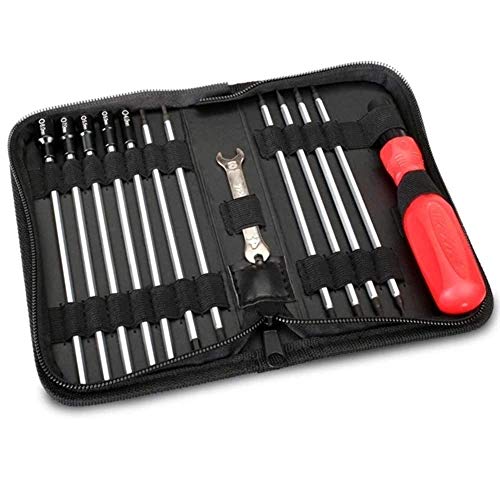
Pinion sets, a thermometer and the drivers to swap them. Picked from current listings.
$6.99 listed price, changes often
Check price on Amazon- Motor heat risk
- Moderate
- Top speed before
- 24.0 mph
- Top speed after
- 26.7 mph
- Final drive before
- 13.00:1
- Final drive after
- 11.70:1
- A noticeable step up. Check the motor and ESC temperature after two to three minutes, with an infrared thermometer if you have one.
The formula
speed change % = (new pinion / new spur) / (old pinion / old spur) - 1
FDR = spur / pinion x internal ratio
The heat rating compares the new gearing to your current gearing. It assumes the current gearing runs at a sensible temperature. If your motor is already hot, gear down, not up.
Pinion sets, a thermometer and the drivers to swap them
Picked from current listings across the price range, so there is a budget, a middle and a premium option in each category.


How much faster is one more pinion tooth?
At a fixed spur, speed scales with pinion teeth, so each tooth is worth less as the pinion grows.
| Change | Speed change | Heat risk |
|---|---|---|
| 14T to 15T | +7.1% | Moderate |
| 18T to 19T | +5.6% | Low |
| 18T to 20T | +11.1% | Moderate |
| 18T to 22T | +22.2% | High |
| 24T to 25T | +4.2% | Low |
Every common pairing has its own page with the numbers worked out: see the gear ratio pages, for example 18T on an 86T spur.
How hot is too hot for an RC motor?
A commonly cited ceiling for brushless motors is around 160 to 170 F (about 71 to 77 C) measured on the can after a run, with many drivers aiming to stay below 150 F. If you cannot hold a finger on the motor for five seconds, gear down. See the motor temperature guide.
Should I change the pinion or the spur?
Pinion first. Pinions are cheaper, easier to reach and come in one-tooth steps, so you can fine tune. Change the spur when you run out of pinion range, when the motor mount will not slide far enough, or when you need a big change such as moving from 2S bashing to 3S. Keep the pitch the same on both: a 48P pinion will not mesh with a 32P or 0.8 module spur. See how to change a pinion gear.
Get this list emailed to you
Every pick on this page with its current price in one email, so you can decide later. One email, no sequence.
Frequently asked questions
Does a smaller pinion make the motor cooler?
Yes. A smaller pinion lowers the gear ratio the motor has to push, so it draws less current at every speed and runs cooler. The trade is lower top speed, often with snappier acceleration. Gearing down one or two teeth is the standard fix for a motor that comes back too hot to touch, especially on 3S, bigger tires or long grass.
How do I know what pinion size to use?
Start from the gearing chart in the manual for your battery and motor. Then adjust by one or two teeth at a time based on temperature and where you drive: larger for smooth, open ground; smaller for grass, hills, jumps and higher cell counts. This calculator shows the speed change and heat risk before you buy the pinion.
What happens if gear mesh is too tight?
A tight mesh drags the motor, wastes power, builds heat and wears the spur quickly, often with a whine you can hear. Too loose and the pinion can strip the spur teeth on a hard landing. The usual method is a strip of paper between the gears while you tighten the motor, then remove it for a tiny amount of play.
Can I use a 32P pinion on a 48P spur?
No. Pitch describes tooth size, and gears only mesh with the same pitch. A 48P pinion needs a 48P spur, a 32P pinion a 32P spur, and a Mod 1 pinion a Mod 1 spur. Module 0.8 and 32P are close but not identical, so mixing them causes noise and wear. Check the pitch printed on the spur or in the manual.
Is gearing up bad for an ESC?
It raises current through the ESC as well as the motor, so it can overheat an ESC that was near its limit. Most ESCs have thermal protection that cuts power, which you will notice as the car slowing or stopping. If that happens after a gearing change, go back down a tooth or add cooling rather than ignoring the warning.
RCCarCalc is researched guidance, not professional advice. Figures come from published manufacturer specifications, listings and verified owner reports, not hands-on testing. Speeds are theoretical or as listed; real results depend on gearing, battery, tires and terrain. See how we research.