2S vs 3S LiPo
Going from 2S (7.4V) to 3S (11.1V) increases motor RPM by exactly 50 percent for the same motor, since RPM equals KV times voltage. A HOOVO 2S 5200mAh 80C pack at $18.99 gives a stock-geared truck its rated speed, while a OVONIC 3S 6000mAh 100C at $34.99 pushes 50 percent more RPM through the same motor, and usually needs a gearing-down (a smaller pinion or larger spur) to keep heat and current draw under control.

HOOVO 7.4V 80C 5200mAh 2S Lipo Battery with TR Plug Hard Case
- 2S
- 5200mAh
5200mAh at 80C for $18.99, a safe match for factory 2S gearing.
$18.99 listed price, changes often
Check price on AmazonThe jump from 2S to 3S LiPo is one of the most common upgrades in the hobby and one of the most misunderstood. The voltage math is simple and exact: motor RPM equals KV rating times voltage, so moving from 7.4V (2S) to 11.1V (3S) is a flat 50 percent increase in motor RPM for the identical motor, no exceptions. What is not simple is what that 50 percent does to everything downstream: the ESC and motor draw more current to sustain that RPM under load, both run meaningfully hotter, and the drivetrain (spur gear, pinion, diffs, driveshafts) sees more stress at the same wheel speed. The responsible way to run 3S in a truck designed around 2S is to gear down, use a smaller pinion or a larger spur, so the final wheel RPM increase is smaller than the raw 50 percent voltage jump, trading away some of the speed gain for a motor and ESC that stay within their thermal limits. Many hobby-grade trucks (check the specific model, not every truck is rated for 3S) support the swap safely with proper gearing; others explicitly are not rated for 3S and risk cooking the ESC.
| 2S (7.4V) | 3S (11.1V) | |
|---|---|---|
| Nominal voltage | 7.4V | 11.1V |
| RPM vs 2S for the same motor | Baseline | +50 percent (RPM = KV x volts) |
| Example pack price | $18.99 HOOVO 2S 5200mAh 80C | $34.99 OVONIC 3S 6000mAh 100C |
| Current draw at a given power | Lower for the same wattage | Lower current for the same wattage than higher-voltage-lower-current setups, but real-world draw is usually higher because more power is used, not less |
| Heat in motor and ESC | Baseline | Meaningfully higher, the main reason to gear down |
| Gearing recommendation | Run stock gearing as designed | Gear down (smaller pinion or larger spur) unless the truck is factory 3S-rated |
| Common risk if run stock-geared | Low risk, matches factory spec | ESC or motor overheating, stripped gears, melted connectors on unrated trucks |
| Typical use case | Entry to mid-tier bashers, most crawlers | Mid to high-tier bashers explicitly rated for 3S, race-oriented trucks |
| Connector demands | Standard connectors handle stock current fine | Higher current benefits from a lower-resistance connector (EC5/XT60 over basic T-plug) to reduce heat at the connector |
| Runtime for equal mAh | Similar minutes per mAh, current draw is the real variable | Runtime often drops somewhat since higher speed usually means higher average current draw |
2S LiPo (7.4V)
Stock voltage for most entry and mid-tier trucks. Lower current draw, lower heat, matches the gearing most trucks ship with.
Best for: Stock or entry-level trucks not rated for higher voltage
HOOVO 7.4V 80C 5200mAh 2S Lipo Battery with TR Plug Hard Case
- 2S
- 5200mAh
$18.99 listed price, changes often
Check price on Amazon3S LiPo (11.1V)
50 percent more motor RPM than 2S for the same motor. Needs a rated ESC/motor and usually a gearing-down to manage heat.
Best for: Trucks explicitly rated for 3S, or 2S trucks regeared for the higher voltage
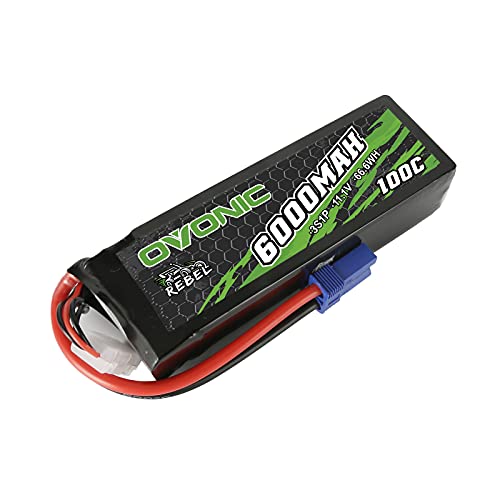
OVONIC 3S Lipo Battery 100C 6000mAh 11.1V Lipo Battery with EC5
- 1/5
- 3S
- 6000mAh
$34.99 listed price, changes often
Check price on AmazonHow much faster is 3S than 2S, exactly?
Motor RPM equals KV rating multiplied by voltage. A 3500KV motor on 2S (7.4V) spins at 3500 x 7.4 = 25,900 RPM. The same motor on 3S (11.1V) spins at 3500 x 11.1 = 38,850 RPM, an increase of exactly 50 percent, since 11.1V is exactly 1.5 times 7.4V. That 50 percent increase in motor RPM carries through to wheel RPM and top speed if gearing is left unchanged: wheel RPM equals motor RPM divided by the final drive ratio, and top speed in mph equals wheel RPM times tire diameter in inches times pi times 60, divided by 63,360. So a truck theoretically rated for 35 mph on 2S would be rated for roughly 52.5 mph on 3S with identical gearing, before accounting for the usual 80-90 percent real-world speed factor and before accounting for whether the motor, ESC, and drivetrain can actually survive running at that RPM continuously.
Why do people gear down when switching to 3S?
The RPM math is exact, but the thermal and mechanical reality is not free. Running 50 percent more RPM through the same motor means the motor and ESC are working harder and generating more heat, and the drivetrain (spur gear, pinion, differentials, driveshafts) is spinning faster and transmitting more torque at the same time. Gearing down, installing a smaller pinion gear or a larger spur gear, lowers the final drive ratio, which brings wheel RPM back down closer to what it was on 2S even though the motor is still spinning faster from the higher voltage. This trades away some of the raw speed increase in exchange for a motor, ESC, and drivetrain that run cooler and last longer. Use the pinion and spur swap calculator to find a gear combination that keeps wheel RPM, and therefore heat, in a safer range after adding a cell.
A rule of thumb some experienced hobbyists follow: if the truck is not explicitly rated by the manufacturer for 3S, treat the first few runs on 3S as a heat test, check motor and ESC temperature with an infrared thermometer after a short run rather than immediately running a full battery, and gear down at the first sign the components are running hotter than they did on 2S.
Does 3S drain the battery faster?
Not necessarily in terms of raw current per unit of power, but in practice, yes, because most drivers who add a cell also drive faster and harder, which increases average current draw. Runtime in minutes equals (mAh / 1000) times 0.8 usable capacity, divided by average amps, times 60. A 6000mAh 3S pack like the OVONIC 3S 6000mAh 100C at an average draw of 20A works out to (6.0 x 0.8 / 20) x 60, about 14.4 minutes. The same pack size at 2S, driven more conservatively at 15A average, would run longer per the same math, roughly 19.2 minutes. The difference is driving behavior as much as the extra cell itself. Use the LiPo runtime calculator with realistic average draw for the specific truck and driving style.
Is my truck rated for 3S?
Check the manufacturer's specific listing for the model before assuming. Many current RTR trucks, especially higher-tier bashers, list 3S compatibility directly, for example several entries in this catalog specify "3S" in their listed specs. Trucks that only list 2S compatibility can often still handle 3S with a gearing-down and careful heat monitoring, but doing so is a modification the manufacturer has not tested for, and it can void a warranty or damage an ESC not rated for the higher voltage. When in doubt, buy a 3S-rated ESC and motor combo as an upgrade rather than assuming a stock 2S electronics package will tolerate the extra voltage indefinitely.
What to buy
Best 3S pack for rated trucks
OVONIC 3S Lipo Battery 100C 6000mAh 11.1V Lipo Battery with EC5
6000mAh at 100C for $34.99, solid capacity for the added current demand of 3S.
$34.99
View on Amazon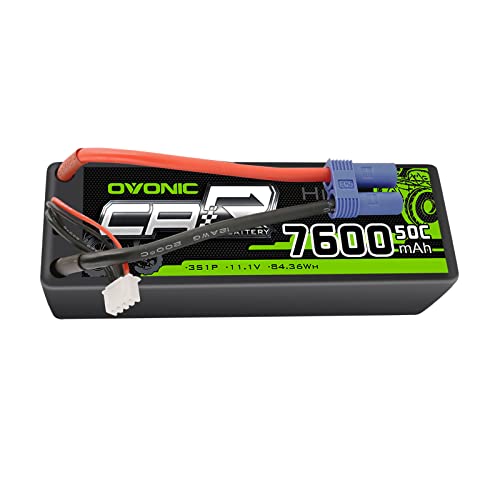 Best higher-capacity 3S option
OVONIC 3s Lipo Battery 11.1V 7600mAh 50C(MAX 100C) RC Lipo
7600mAh at up to 100C for longer runtime on a hard-driven 3S basher.
$35.99
View on Amazon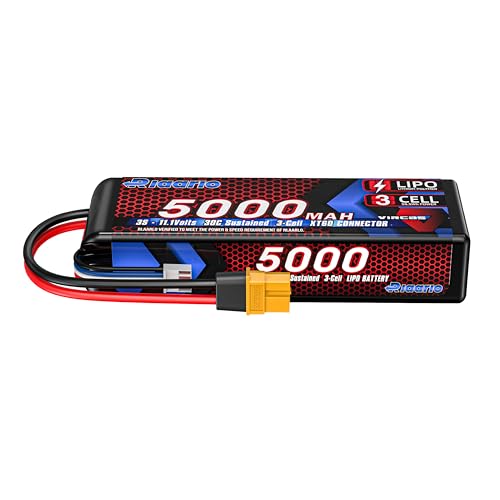 Best low-C budget 3S pack
RIAARIO 3s Lipo Battery 30C 5000mAh 11.1V Lipo Battery
5000mAh at 30C for $59.99, adequate for lower-demand 3S setups without paying for discharge rate you won't use.
$59.99
View on AmazonGet this list emailed to you
Every pick on this page with its current price in one email, so you can decide later. One email, no sequence.
Frequently asked questions
Is 3S exactly 50 percent faster than 2S?
For the same motor and gearing, yes. Motor RPM equals KV times voltage, and 11.1V (3S) is exactly 1.5 times 7.4V (2S), so RPM increases by exactly 50 percent. Real-world top speed also depends on gearing, tire diameter, and how much of the theoretical speed the truck actually achieves (usually 80-90 percent), but the underlying motor RPM math is exact.
Do I need to gear down when switching from 2S to 3S?
It is strongly recommended unless the truck is factory-rated for 3S with its stock gearing. Gearing down, using a smaller pinion or larger spur gear, keeps final wheel RPM closer to the 2S baseline even with the higher motor RPM, which reduces heat in the motor and ESC and stress on the drivetrain.
Can I damage my truck by running 3S in a 2S-rated ESC?
Yes. An ESC not rated for 3S voltage can overheat, shut down mid-run, or be permanently damaged. Always check the ESC's specific voltage rating, printed on the unit or in the manual, before switching cell counts, not just the truck's general marketing.
Does 3S make the battery run out faster?
Not purely from the voltage increase itself, but in practice most drivers use more throttle and drive faster on 3S, which increases average current draw and shortens runtime for a given battery capacity. Use the LiPo runtime calculator with a realistic average amp draw to estimate actual runtime.
How do I know if my truck supports 3S?
Check the specific model's manufacturer listing or manual for a stated cell count rating, several trucks in this catalog explicitly list "3S" or "4S" in their specs. If 3S is not listed, assume it is not rated without a gearing and electronics review, and consider it a modification rather than an intended use.
RCCarCalc is researched guidance, not professional advice. Figures come from published manufacturer specifications, listings and verified owner reports, not hands-on testing. Speeds are theoretical or as listed; real results depend on gearing, battery, tires and terrain. See how we research.