What KV Motor for an RC Car?
For most 1/10 scale 2S-3S bashers, a motor in the roughly 3000-4500 KV range, like the Hobby Fans S3650 4300KV Brushless Motor at $53.99, balances usable torque with a real top speed gain over stock. Crawlers want the opposite: something closer to 1400-2200 KV for low-speed torque and control.
KV is how many RPM a motor spins per volt with no load, so a higher KV number always means a faster-spinning, lower-torque motor at a given voltage, all else equal.

Hobby Fans Waterproof S3650 4300KV Brushless Motor 3.175mm
- 1/10
- Brushless
A 4300KV brushless motor with a 60A ESC included, waterproofed for outdoor bashing. Sits right in the middle of the typical 1/10 range and pairs well with 2S or 3S.
$53.99 listed price, changes often
Check price on AmazonWhat does the KV number on a motor actually mean?
Motor RPM equals KV multiplied by voltage. A 4300KV motor on a 2S pack (7.4V nominal) spins at roughly 4300 x 7.4, or about 31,800 RPM with no load. The same 4300KV motor on 3S (11.1V) spins close to 47,700 RPM, which is why cell count and KV are always chosen together, not independently.
KV itself comes from how the motor is wound: fewer turns of thicker wire gives higher KV and lower torque per amp, while more turns of thinner wire gives lower KV and more torque per amp at the same physical motor size. See motor turns vs KV for that relationship in more depth.
What KV motor is right for your scale and cell count?
As a general rule, KV trends down as cell count and vehicle weight go up, which keeps motor RPM, and the heat that comes with it, inside a sane range. A heavy 1/8 scale truck on 6S with a high-KV motor built for a light 1/16 basher would spin dangerously fast and hot; a crawler with a high-KV motor would have plenty of speed and almost no low-end control.
| Scale / type | Typical cell count | Typical KV range |
|---|---|---|
| Crawler (any scale) | 2S-3S | 1400-2200 KV |
| 1/18-1/16 basher | 2S | 3000-4500 KV |
| 1/10 2WD short course / stadium | 2S-3S | 3000-4500 KV |
| 1/10 4WD monster / basher | 3S-4S | 1900-3000 KV |
| 1/8 buggy / truggy | 4S-6S | 1300-2200 KV |
| 1/7-1/5 speed / basher | 6S-8S | 1100-1900 KV |
Why do crawlers use such low KV motors?
Crawlers care about torque and control at a crawl, not top speed. A low KV motor spins slower for a given voltage, which lets the driver modulate throttle finely at very low wheel speed, exactly what technical rock crawling and precise line-picking need. Combined with deep internal gearing, a low KV motor gives huge torque multiplication at the wheel while keeping RPM, and heat, low. See RC crawler overdrive vs underdrive for how that pairs with axle gearing.
A purpose-built option like the Spektrum Firma 2-in-1 Brushless Crawler Motor/ESC at 1400Kv, priced at $179.99, is a good example: it is tuned specifically for crawling rather than repurposing a basher motor at the wrong KV.
What happens if you put too high a KV motor in your car?
Excess RPM at a given voltage means excess current draw and excess heat, since the motor and ESC both have to work harder to control the extra speed. See the RC motor temperature guide for what to watch for. Beyond heat, a stock gearbox rated for a lower-torque, lower-heat setup can also wear out or strip faster under the higher loads a mismatched high-KV swap creates, especially the differential gears.
Worked example: how do you pick a KV for a target top speed?
Working backward from a target speed is often more useful than picking a KV number off a chart. If you know your gearing (final drive ratio) and tire diameter, you can solve for the KV that gets you close to a specific real-world speed target.
Sensored vs sensorless brushless: does KV selection change?
No, the KV target for your scale and cell count stays the same either way. What changes is low-speed smoothness: a sensored motor, like the Spektrum Firma Sensored 2800Kv Motor/ESC Combo at $81.99, uses position sensors to give smoother, more precise control at low throttle, which matters more for crawling and technical driving than for straight-line bashing. A sensorless motor at the same KV is perfectly fine for general bashing, where fine low-speed control matters less.
Solving for KV given a target speed
- Target: about 30 mph real-world on 3S (11.1V), with a final drive ratio (FDR) of 9.0 and a 3.9 inch tire diameter.
- Since real-world speed is usually 80-90 percent of theoretical, the theoretical target is roughly 30 / 0.85, or about 35.3 mph.
- Wheel RPM = theoretical mph x 63,360 / (tire diameter x pi x 60) = 35.3 x 63,360 / (3.9 x pi x 60), which works out to about 3,044 RPM.
- Motor RPM = wheel RPM x FDR = 3,044 x 9.0 = about 27,400 RPM.
- KV = motor RPM / volts = 27,400 / 11.1, or roughly 2,470 KV, which rounds to a common off-the-shelf 2500KV motor for this gearing and cell count.
Gear for this job
 Best lower KV option for torque over top speed
Gecko 3660 1800KV Motor +40A ESC Integrated Motor & ESC
An 1800KV motor with an integrated 40A ESC and a program card. Lower KV trades some top speed for more torque, useful on heavier 4WD trucks or higher cell counts.
$95.98
View on Amazon Best crawler-specific low KV combo
Spektrum Firma 2-in-1 Brushless Crawler Motor/ESC: 1400Kv
A 1400Kv motor and ESC built specifically for crawling, not a repurposed basher motor. Low KV gives fine throttle control at a crawl instead of extra speed you don't need.
$179.99
View on Amazon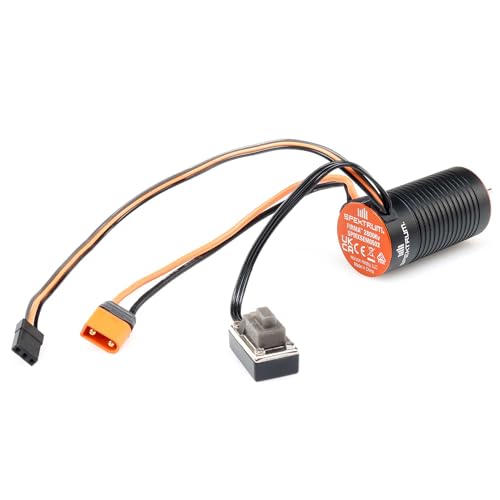 Best sensored combo for smooth low-speed control
Spektrum Accessories Firma Sensored BL Motor/ESC 2-in-1 Combo
A 2800Kv sensored motor and ESC combo. The sensored design gives smoother control at low throttle than a sensorless motor at the same KV, useful for technical driving as well as general bashing.
$81.99
View on AmazonGet this list emailed to you
Every pick on this page with its current price in one email, so you can decide later. One email, no sequence.
Frequently asked questions
Is higher KV always faster?
At the same voltage and gearing, yes, higher KV means higher motor RPM and therefore higher potential top speed. But higher KV also means more current draw and heat for the same load, and less low-end torque, so it is only a straightforward upgrade if your gearing, battery and cooling can support it.
What KV motor should I use for a 1/10 scale basher?
Most 1/10 scale 2WD short course and stadium trucks on 2S or 3S land well with a motor in the roughly 3000-4500 KV range. Heavier 1/10 4WD monster trucks and bashers, especially on 3S-4S, generally do better a bit lower, closer to 1900-3000 KV, to keep heat and current draw in check.
Can I put a high KV motor on 6S safely?
Generally no. A motor built for 2S-3S KV ranges (3000KV and up) on 6S voltage would spin far beyond its safe RPM and current limits. 6S and 8S platforms are built around much lower KV motors, typically in the 1100-2200 KV range, specifically so the RPM math stays in a safe zone at that voltage.
What KV is best for a rock crawler?
Crawlers generally use motors in the 1400-2200 KV range. Low KV keeps RPM down and lets a low, steady throttle input translate into fine, controllable wheel speed, which matters far more for crawling over obstacles than raw top speed does.
Does changing KV mean I need to re-gear my car?
Often, yes. Since motor RPM scales directly with KV, swapping to a significantly different KV motor without adjusting your final drive ratio can push wheel speed and motor heat outside a safe range. Use the gear ratio and top speed calculator to check your new numbers before your first run on a different KV motor.
RCCarCalc is researched guidance, not professional advice. Figures come from published manufacturer specifications, listings and verified owner reports, not hands-on testing. Speeds are theoretical or as listed; real results depend on gearing, battery, tires and terrain. See how we research.