RC Car Motor Turns vs KV
Brushed motor turns and brushless KV measure different things and do not convert exactly, but as a rough rule fewer turns behaves like higher KV: a 35T brushed crawler motor spins roughly 11,000 to 12,000 RPM on 7.2 V, about what a 1,500 to 1,700KV brushless motor does on the same voltage.
Motor turns are a count of the wire windings on a brushed motor's armature; motor KV is the unloaded RPM per volt of a brushless motor. Fewer turns and higher KV both mean a faster-spinning, lower-torque motor.
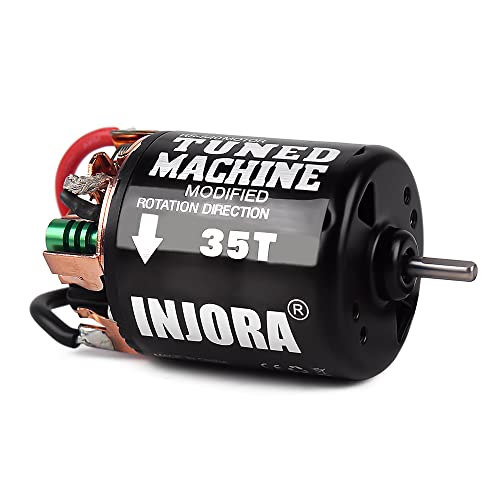
INJORA 540 Brushed Motor 35T Waterproof Motor for 1/10 RC
- 1/10
- Brushed
The INJORA 540 Brushed Motor 35T Waterproof Motor for 1/10 RC Crawler is a direct, stock-like replacement, a safe pick if you just need a working motor rather than a speed upgrade.
$13.98 listed price, changes often
Check price on AmazonWhy do brushed and brushless motors use different ratings?
Brushed and brushless motors are built differently, so the hobby settled on different labels for each. Brushed motors, like the common 540 and 550 can sizes, are rated by turns, the number of times copper wire is wound around the armature. Fewer turns means less resistance and a faster, hotter-running, lower-torque motor; more turns means the opposite.
Brushless motors do not have brushes or a wound armature in the same sense, so the hobby rates them by KV, unloaded RPM per volt, instead. Neither number describes torque, current draw, or heat directly; both are proxies that experienced builders learn to read.
Is there a turns-to-KV conversion?
Not an exact one. Turns and KV come from different motor designs with different magnets, wire gauge, and can sizes, so there is no formula that converts one to the other precisely. What exists is a widely cited, approximate rule of thumb that fewer turns tracks with higher KV in a similar-size motor, useful for getting into the right neighborhood, not for an exact match.
Treat the table below as a starting reference for "this brushed motor feels roughly like this KV range," not as a specification you can rely on for a purchase decision. Always check the actual current draw and heat of whatever you install, regardless of which rating system it uses.
| Brushed turns | Approximate brushless KV equivalent | Character |
|---|---|---|
| 55T | roughly 1,000 to 1,200KV | Very slow crawler motor, maximum torque feel |
| 35T | roughly 1,500 to 1,700KV | Common stock crawler motor, forgiving |
| 27T | roughly 2,000 to 2,300KV | Classic stock 540 in 1/10 cars |
| 21T | roughly 2,500 to 2,800KV | Mild speed upgrade, more current draw |
| 17T | roughly 3,000 to 3,400KV | Fast brushed, runs hot without care |
| 12T | roughly 4,000KV and up | Modified territory, needs matched gearing and cooling |
Watch out: turns and pinion teeth both use the letter T
This trips up a lot of beginners. A "35T" motor means 35 turns of wire on the armature. A "17T" pinion gear means 17 teeth. They are unrelated numbers that happen to share the same abbreviation. When you are reading a listing or a forum post, check whether the T is attached to a motor (turns) or a gear (teeth) before assuming anything about speed.
Should I upgrade my brushed motor's turns, or switch to brushless?
Dropping turns on a brushed motor (going from 55T to 35T, for example) is a cheap, familiar way to add speed to a toy-grade or entry hobby-grade car, and it is a direct swap in most cases. It is also a dead end: brushed motors wear brushes over time and top out well below what brushless can do at a similar price today.
If you are already shopping for a turns upgrade, it is worth pricing out a brushless motor and ESC combo instead. Combos remove the turns-versus-KV guesswork entirely, since the motor and ESC are matched by the manufacturer and rated directly in KV. See brushed vs brushless RC motors for the full comparison.
Gear for this job
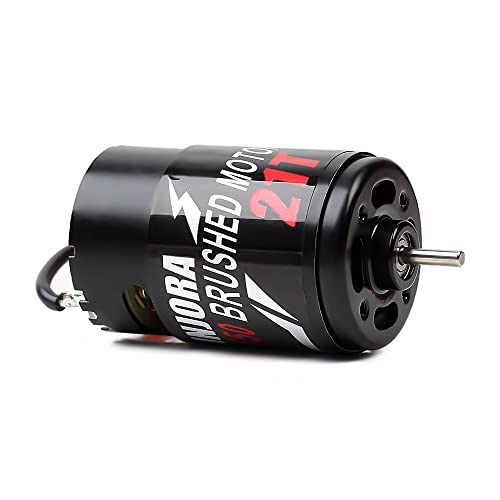 Lower-turn brushed pick for more speed on the same drivetrain
INJORA 550 3-Slot Waterproof Brushed Motor for 1/10 RC Crawler
The INJORA 550 3-Slot Waterproof Brushed Motor, 21T trades some of that stock torque for more speed. Expect it to run warmer than the 35T motor above under the same gearing.
$16.98
View on Amazon Skip the guesswork with a brushless combo instead
Surpass Hobby 3660 2600KV Brushless Motor and ESC 60A 2s Lipo
The Surpass Hobby 3660 2600KV Brushless Motor and ESC 60A Combo gives you a directly comparable KV rating instead of an approximate turns conversion, and a matched ESC to go with it.
$48.99
View on AmazonGet this list emailed to you
Every pick on this page with its current price in one email, so you can decide later. One email, no sequence.
Frequently asked questions
What is RC car motor turns vs KV, in plain terms?
Turns describe brushed motors: the number of wire windings on the armature. KV describes brushless motors: unloaded RPM per volt. Both are proxies for the same underlying tradeoff, speed versus torque and heat, but they are measured differently and do not convert exactly between motor types.
Is a 35T brushed motor the same as a specific KV brushless motor?
Not exactly. As a rough, widely cited approximation, a 35T brushed motor spins roughly like a 1,500 to 1,700KV brushless motor on the same voltage, but the two use different magnets, windings, and thermal characteristics, so treat any turns-to-KV comparison as a ballpark, not a spec.
Does lower turns always mean higher KV-equivalent speed?
Generally yes within the brushed motor world: fewer turns means less wire resistance, which usually means a faster, lower-torque, hotter-running motor, similar in character to a higher-KV brushless motor. It is a directional relationship, not a precise conversion.
Why do people say turns and KV cannot be directly converted?
Because brushed and brushless motors are built on different principles, with different magnet strength, wire gauge, can size, and commutation. Two motors can share a nominal "equivalent" rating from a rule-of-thumb chart and still draw meaningfully different current or run at different temperatures under the same load.
Should a beginner worry about turns vs KV at all?
Only if you are shopping for a motor swap. If your car came with a stock motor, whether brushed or brushless, it was already matched to that chassis and ESC. Turns-versus-KV only becomes relevant once you start comparing an upgrade motor against what you currently have.
RCCarCalc is researched guidance, not professional advice. Figures come from published manufacturer specifications, listings and verified owner reports, not hands-on testing. Speeds are theoretical or as listed; real results depend on gearing, battery, tires and terrain. See how we research.